

What to Look for in a Data Center Controls Integrator
Choosing a controls integrator for a data center is a different evaluation than choosing one for a factory. A production line can absorb a rough afternoon; a data hall cannot. So when you evaluate a data center controls integrator, you are really testing one thing: whether the firm can work inside a facility that has to stay running while they change it, and whether they will still be standing next to you when a control sequence misbehaves at 2 a.m. The credential list matters, but the operating discipline behind it matters more.
According to the International Energy Agency, data centers consumed around 415 TWh of electricity globally in 2024, accounting for about 1.5% of global electricity consumption. The IEA projects data-center electricity consumption could more than double to around 945 TWh by 2030, driven in large part by AI and other high-performance computing workloads. Below is a framework for that evaluation, organized around the questions that actually separate integrators in this environment. Use it to pressure-test a shortlist from any seat at the table: operator, facility engineer, or owner’s representative.
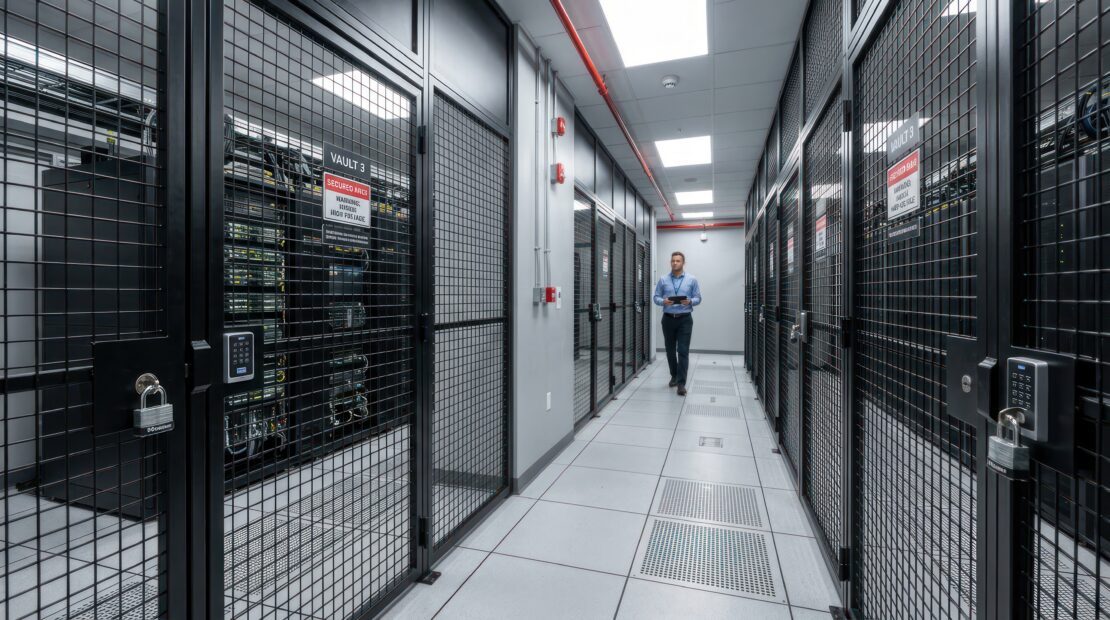
Start with how they talk about uptime and redundancy
Before you look at platforms or logos, listen to how a candidate discusses failure. A strong data center integrator speaks in terms of redundancy topology (N, N+1, 2N), failure modes, and what happens to the controls when a component drops, not only what happens when everything works. Ask a candidate to walk you through how they would sequence a controls change on a system feeding live load without collapsing a redundancy tier. The capable ones answer with a method: isolation boundaries, a tested rollback, and a defined point of no return. The weaker ones answer with reassurance. An integrator who cannot describe how they protect concurrent maintainability is telling you they have not had to.
Confirm real fluency across BMS, EPMS, and critical cooling and power
Data center controls are a stack, not a single system. The building management system (BMS) governs cooling, airflow, and environmental conditions; the electrical power monitoring system (EPMS) watches the power chain from the utility service to the rack. A firm fluent in one and vague on the other will leave you holding the seam between them. Press for specifics on the cooling side (CRAC and CRAH sequencing, chilled water plant control, economizer logic, hot and cold aisle containment) and on the power side (switchgear and PDU monitoring, UPS and generator interfaces, branch-circuit metering). You want an integrator who understands how a cooling response and a power event interact, because in a data hall they rarely stay in separate lanes.
Ask how they manage change on a live, occupied facility
Most data center controls work involves modifying a running site rather than building greenfield, so the risk lives in the transition rather than the end state. A serious integrator brings a change-management posture before they bring code: a written method of procedure for each cutover, a script of expected system responses, agreed abort criteria, and a named person who owns the go or no-go call. Ask what their last three live-site cutovers looked like and what went sideways on one of them. The answer tells you whether they treat a method of procedure as a real safety instrument or a document they fill out afterward. Discipline under a maintenance window is learned on live systems, and it transfers directly from other facilities that cannot go dark, such as pharmaceutical utilities, semiconductor fabs, and continuous-process plants.
Test their ability to integrate across vendors and platforms
Few data centers run on a single manufacturer’s equipment. Chillers, switchgear, UPS systems, generators, and metering often come from different vendors, each speaking its own protocol (BACnet, Modbus, SNMP, and others). The integrator’s job is to make that mixed estate report and respond as one coherent system. A vendor-locked integrator, or one who quietly steers you toward the platform they resell, narrows your options later. Ask how they handle protocol translation, how they normalize points and alarms across dissimilar equipment, and how they document a tag database so your team can maintain it after they leave. Platform independence is a buying advantage here, and an integrator carrying multiple manufacturer certifications has less reason to force a single answer.
Look for commissioning rigor, not installation speed
The difference between an integrator who installs controls and one who commissions them shows up during Level 4 and Level 5 testing, when the systems are exercised together under simulated failure. Ask how the candidate participates in integrated systems testing: do they script failure scenarios, pull a utility feed, fail a cooling unit, and prove the sequences respond as designed? Do they stay through functional performance testing, or do they hand off after point-to-point checkout? Commissioning is where design intent meets reality, and an integrator who treats it as the finish line rather than a formality is the one who catches the sequence gap before it becomes an outage. Ask to see a sample commissioning record from a comparable project.
Weigh execution follow-through above the pitch
The most common failure in controls integration is not technical, it is abandonment: the firm that wins the work, installs the visible parts, and drifts once the punch list gets tedious. In a data center that pattern is expensive, because the loose ends are alarms that never got tuned and sequences that were never fully proven. Evaluate follow-through directly. Ask references one question: when something went wrong after go-live, who showed up, and how fast? A firm that owns the outcome through steady-state operation, not only through substantial completion, is worth more than a lower bid that ends at the ribbon cutting.
Where a cross-industry integrator earns the seat
Data centers are a newer vertical for many capable industrial integrators, and honesty on that point should count in your evaluation rather than against it. The disciplines that make a data center project succeed, redundancy awareness, live-site change management, multi-vendor integration, and commissioning rigor, are the same disciplines proven in pharmaceutical, semiconductor, automotive, and aerospace facilities that also cannot afford unplanned downtime. Patti Engineering approaches data center controls from that adjacent track record: over 35 years of control systems integration in plants where a contamination event, a safety trip, or a stopped line carries a real cost. The mechanics of a data hall’s BMS and power monitoring are not identical to a clean-utility system, and any integrator claiming otherwise is overselling. The judgment about how to change a critical system without breaking it does carry across. When you evaluate an integrator whose data center logos are still accumulating, weigh the transferable discipline and the platform breadth behind it, then confirm it the way you would confirm any claim: with references and a walkthrough of real work.
Frequently Asked Questions
A data center controls integrator designs, programs, and commissions the systems that monitor and automate a facility’s cooling, power, and environmental infrastructure, then makes those systems work together across vendors. A BMS contractor typically installs and services one building management platform. The integrator’s role is broader: unifying the BMS, the EPMS, and the equipment-level controls into a coherent system with consistent alarming and reliable failure response. For a facility where redundancy and uptime govern the design, that integration layer is where reliability is won or lost.
Look for demonstrated work in facilities that cannot tolerate downtime, even if the logo is not a data center. Continuous-process plants, pharmaceutical utilities, and semiconductor fabs all demand the same core competencies: redundancy discipline, tightly controlled change on live systems, and integrated commissioning. Direct data center experience is valuable, but a firm with deep criticality experience in an adjacent industry and a serious approach to learning your specific topology can outperform a firm that has done data center work carelessly. Ask for the reasoning behind their decisions, not only the project names.
Every change to a live facility should run through a written method of procedure that defines the steps, the expected system responses, the abort criteria, and the person authorized to stop the work. Before touching a controller feeding live load, a good integrator confirms the redundancy path, isolates the smallest possible scope, and keeps a tested rollback ready. The maintenance window is planned backward from the safest recovery point. If an integrator cannot produce a sample method of procedure, treat that as a signal that live-site work is unfamiliar territory for them.
Certifications tell you about rigor and platform depth rather than data center pedigree specifically. CSIA certification signals independently audited business and engineering practices. Manufacturer credentials, such as Siemens and Ignition credentials, show validated platform depth. Patti Engineering holds CSIA certification, Platinum Siemens Certified Solution Partner status, Inductive Automation Premier Integrator status, and FANUC Authorized System Integrator status. Certifications are a floor, not a finish. Confirm that the certified expertise maps to the specific systems in your facility.
An equipment vendor’s team knows its own gear well, but it has a structural reason to keep you inside its ecosystem, which can complicate integration with the rest of a multi-vendor facility. An independent integrator is positioned to make dissimilar systems work together and to represent your interests across the whole estate. The stronger choice usually depends on how mixed your infrastructure is: the more vendors in the room, the more an independent, platform-neutral integrator earns its place. Ask either candidate how they document the system so your own team can maintain it afterward.
Ask references about the moments that reveal character rather than competence. Focus on how the integrator handled a change that did not go as planned, and on who answered the phone after go-live when an issue surfaced. Find out whether commissioning caught problems before they reached operations or the operators found them first. One last question tends to be the most revealing: would the reference hire the firm again for a harder project? References confirm the two things a proposal cannot, namely whether the firm holds its discipline under pressure and whether it sees the work through past the point where it stops being glamorous.
Ready to evaluate the fit
If you are scoping a data center controls project and weighing who can execute it safely on a live facility, Patti Engineering is glad to walk you through our approach, our platform certifications, and the transferable criticality experience behind them, honestly and without overstating a data center track record still being built. For the systems-level primer, see our overview of data center controls, and for the integration layer specifically, our guide to BMS integration for data centers. When you are ready for a direct conversation, reach out for honest advice from a team that finishes what it starts.
Related categories: Blog Data Centers