
Siemens Control Systems: Understanding Product Lifecycles
Siemens defines five clear stages of their product life cycle, defining when products are active, when phase-out begins, and when support eventually ends. As Siemens equipment ages and moves towards obsolescence, it becomes increasingly difficult and costly to keep control systems running efficiently.
Note that it is normal and expected for these components to fail and require replacement long before the line’s mechanical equipment. As a result, control system upgrades are a necessary part of long-term production line maintenance, and usually the most effective way to maximize both a line’s longevity and overall equipment effectiveness (OEE) metrics while minimizing costs.
By understanding each of the Siemens lifecycle phases, manufacturers can anticipate product and software availability, plan spare parts strategies, and schedule equipment upgrades before obsolescence creates unnecessary risk.
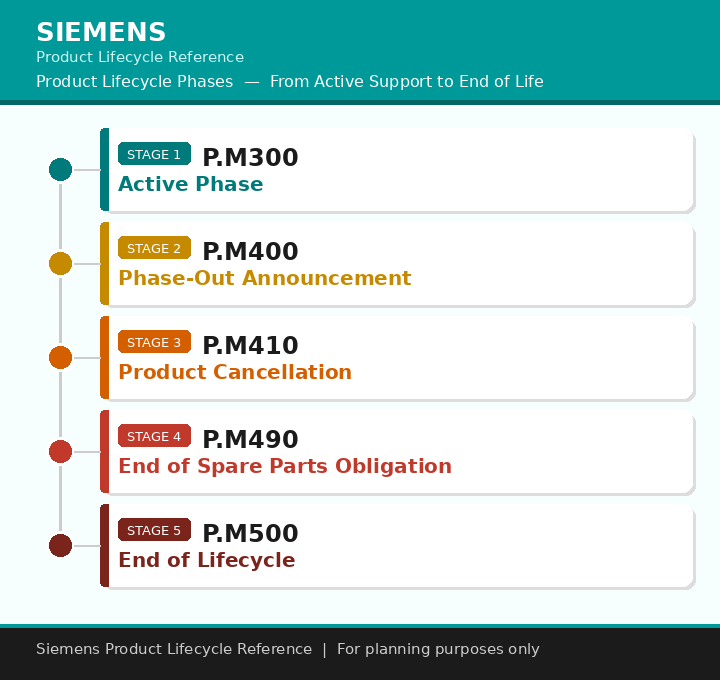
Product Lifecycle Stage 1: P.M300 (Active Phase)
- The product is fully supported by Siemens and available for purchase as a new item.
- Spare parts, accessories, and software updates are readily available.
- The product is recommended for use in new projects and system expansions.
- Manufacturers can rely on long-term availability, ongoing software development, and standard lead times during this phase.
Product Lifecycle Stage 2: P.M400 (Phase-Out Announcement)
- Siemens formally announces the product’s planned discontinuation.
- The product can still be purchased new at this time.
- Their 10-year spare-parts commitment* begins on this date.
- The announcement includes the anticipated P.M410 date, when the product will no longer be available for purchase.
- Firmware updates and security patches remain available, though no new functionality is added.
*Siemens 10‑year spare‑parts guarantee always counts from the P.M400 date, not from P.M410 (product cancellation). That means if P.M400 is announced in 2023, Siemens commits spares until 2033, regardless of the associated P.M410 date.
Product Lifecycle Stage 3: P.M410 (Product Cancellation)
- Siemens stops selling the product as a new item.
- From this date forward, the product is available only as a spare part to support existing installations. Complete modules (e.g., PLCs, CPUs, power supplies, I/O cards) can still be purchased for one-to-one replacement in legacy systems.
- Spare parts supply is supported under the 10-year guarantee that began at P.M400.
- Firmware and security updates continue within the spare-parts window, but engineering software enters legacy status and only receives maintenance patches.
- Lead times and prices for spare parts often increase after this milestone.
Product Lifecycle Stage 4: P.M490 (End of Spare Parts Obligation)
- The 10-year spare-parts commitment that began on the date of the P.M400 announcement expires.
- Siemens is no longer obligated to manufacture or provide spare parts.
- Availability is limited to existing Siemens stock or third-party suppliers.
- Software and firmware updates stop; users must rely on whatever versions were last released.
- Manufacturers who have not yet migrated by this point face a significant downtime risk if equipment fails due to parts scarcity.
Product Lifecycle Stage 5: P.M500 (End of Lifecycle)
- Siemens discontinues all repair services, technical support, and spare parts provision for the product.
- The product is considered fully obsolete within Siemens’ portfolio.
- Any needed replacement parts must be sourced from secondary markets.
- Archived software downloads and updates are no longer supported, leaving users without Siemens technical or update assistance.
- Manufacturers that continue running the product beyond this point operate without Siemens support.
Control System Equipment Statuses
The table below shows commonly used Siemens control equipment that is currently in some phase of product discontinuation, its discontinuation status, recommended upgrade, and the relevant Siemens discontinuation notice.
| Siemens Legacy Product | Product Lifecycle Status | Recommended Upgrade | Siemens Notice |
| SIMATIC S7‑300 PLCs | P.M400: Oct 1, 2023 P.M410: Oct 1, 2025 | S7‑1500 | View |
| SIMATIC S7‑200 PLCs | P.M410: Oct 1, 2014 | S7‑1200 | View |
| SIMATIC ET 200M I/O | P.M400: Oct 1, 2023 P.M410: Oct 1, 2025 | ET 200MP | View |
| SIMATIC ET 200S I/O | P.M400: P.M410: Oct 1, 2023 | ET 200SP | View |
| HMI MP277 | P.M400: Oct 1, 2011 P.M410: Oct 1, 2019 | Unified Comfort Panels | View |
| HMI Comfort Panels ≥15″ | P.M400: Oct 1, 2024 P.M410: TBD | Unified Comfort Panels | View |
| SIMATIC RF180C RFID | P.M400: Oct 1, 2019 P.M410: Sept 30, 2020 | RF185C / RF186C / RF188C | View |
| SINAMICS S210 (6SL3) | P.M400: Sep 30, 2025 P.M410: Oct 1, 2025 P.M490: Oct 1, 2034 | S210/6SL5 | View |
| SIMOTICS-M 1PH7 AH160 | P.M490: Oct 1, 2026 | Series 1PH8 | View |
| ET 200SP IM 155-6 PN/3 HF | P.M400: Oct 1, 2026 P.M490: Oct 1, 2036 | IM 155-6 MF HF (with suitable Scalance switch) | View |
Is Your Siemens Control Equipment Obsolete?
It’s common for Siemens’ control equipment to phase out. In fact, most electronic equipment in control systems has a 15-year maximum lifespan. If your control system needs an upgrade, get help from our experts at Patti Engineering.
Founded in 1991, Patti Engineering is a consulting firm with experience in robotics, control systems integration, Industry 4.0, and more. Manufacturing elites, including Siemens, FANUC, Ignition, and Mitsubishi, have certified our practices and skills.
Visit our website to learn more about our services, or contact us today to schedule a consultation.
FAQs
What Is the Siemens Product Lifecycle?
Siemens has a five-stage product lifecycle:
- P.M300, for active products
- P.M400, when a planned discontinuation of a product is announced
- P.M410, when a product is officially cancelled
- P.M490, when Siemens’ 10-year spare part obligation ends
- P.M500, when all support services for the product are discontinued
Why Is It Necessary to Replace Siemens Parts?
The product will eventually be discontinued entirely, meaning that no spare parts can be purchased for this component, and any necessary firmware or software updates won’t occur, posing a security risk.
What Is Siemens’ Spare Parts Obligation?
When Siemens officially cancels a product, there is a 10-year period in which Siemens will provide spare parts to help facilities maintain their components.
When Does Software or Firmware Support for Siemens End?
Firmware and software support for Siemens products ends once the product reaches the P.M500 stage.
What Is the Difference Between Siemens’ Phase-Out and Cancellation Stages?
In the P.M400 phase, the product is planned to be cancelled, but it can still be purchased new. Once the product reaches the P.M410 (product cancellation) stage, it’s no longer available as a new item, but spare parts will be supplied until the part reaches the P.M490 stage.
Where Does Siemens Post Product Announcements?
Siemens posts announcements within their Knowledge Base.