

From Baseball to Manufacturing, Data Analytics Win
Artificial intelligence-based tools provide remarkable insights leading to improvements in any domain that can be characterized with data. By investing in data integration strategies, industrial manufacturing stands poised to improve all facets of overall equipment effectiveness (OEE) from AI-based tools.
Over the past five years, the Tampa Bay Rays have seemingly done the impossible – they have consistently outperformed expectations, securing more division titles and wins than almost any other Major League Baseball team, all while operating on a fraction of their competitors’ budgets. From scouting players to defensive alignments and roster construction, their managers seem to have all the right answers guiding their decisions that win the games.
The Rays’ shocking success is neither luck nor magic. Instead, it is attributed to their innovative and highly effective use of data analytics to optimize team performance and operational efficiency – the Major League Baseball equivalent of manufacturing’s overall equipment effectiveness (OEE) measurement. With enough datasets describing each player, the entire team-system can be mathematically modeled using a type of artificial intelligence (AI) called machine learning (ML), and the results speak for themselves.
Similar to the Tampa Bay Ray’s use of analytics, AI-based tools have become widely available to model, characterize, and optimize nearly every part of a manufacturing operation. These tools are fueled by diverse data that describes the system – abundant in any manufacturing facility. The tools’ insights show how to increase uptime, reduce costs, and improve quality by facilitating system diagnostics, predicting maintenance needs prior to equipment failure, and improving vision inspection reliability. While manufacturers commonly struggle with data accessibility and useability, investing in foundational steps to overcome this hurdle is essential for maintaining current and future competitiveness. If the Tampa Bay Rays can use analytics to outperform their competitors on a fraction of their budgets, imagine the potential for the manufacturing industry.
Root Cause Analysis of Faults and Predictive Maintenance
A common vexing automation challenge faced by manufacturers involves prolonged downtime associated with equipment failures of unclear origin. These incidents result in a cascade of stressful, reactive engineering and maintenance efforts, and a significant loss of productivity. Data analytics is a particularly powerful means of addressing this problem. By analyzing historical data, machine learning algorithms can learn to identify the patterns that have previously led to faults from past incidents. This capability not only speeds up diagnostics but also helps manufacturers transition from reactive to proactive maintenance, enabling them to predict issues and plan for their remediation prior to an expensive failure.
Consider a recent project that Patti Engineering completed on behalf of a large industrial manufacturer who suffered a major press failure, halting production and ultimately costing the company over a million dollars in repair costs. Had they known that the servo drive controlling the press was on the verge of failure, the issue could have been fixed for a fraction of the cost, around $10,000.
Predictive maintenance strategies provide exactly this kind of foresight. Their implementation involves the strategic addition of sensors to the system, each providing ongoing valuable data describing the machine’s overall health. In the case of the press’ servo drive, vibration sensors (accelerometers) positioned close to the bearing housings of the servo motor may have measured changes in vibration possibly stemming from bearing wear. Likewise, a temperature sensor positioned near the motor’s windings may have measured higher operating temperatures indicative of increased winding resistivity or insulation breakdown. Overheating faults can also occur when the power electronics within a drive begin to fail, so a sensor monitoring its ambient operating temperature may have noticed it increasing.
In conjunction with other relevant system datasets (for example, power consumption), the sensors’ datapoints can be analyzed and modeled by various machine learning-based platforms providing manufacturers with insights into anomaly behavior well ahead of a dramatic failure like that of the press. Cloud-based analytics platforms from Amazon Web Services (AWS) or Microsoft Azure can be used for this purpose. As a result, industrial maintenance transitions to a streamlined proactive approach that minimizes downtime, reduces repair costs, and maximizes equipment lifespan.
System Integrators are Equipped to Address the Challenge of Disparate Data Sources
While the benefits of advanced analytics-based applications are clear, they require access to clean, ready-to-use data that can accurately describe and therefore model the target system. Within the manufacturing industry, the hurdles to achieving this data-readiness are multi-faceted. Disparate and siloed data sources using different standards, protocols, and formats with potentially differing reporting rates and accuracies must be addressed. This challenge is uniquely suited to system integrators, who possess comprehensive knowledge of diverse vendors’ equipment and platforms and are skilled in creating interoperable systems.

Legacy System Integration with Arduino’s Opta
Another challenge to data integration within industrial manufacturing is the prevalence of legacy systems. Because they were not originally designed with current data needs in mind, the required datasets often do not natively exist within these systems. Compounding the problem, legacy systems are more prone to downtime events of unclear origin due to their age. Determining the cause of these events takes significant time, which takes a large toll on the manufacturer’s OEE.
To address this common problem, Patti Engineering has partnered with Arduino. Arduino’s Opta facilitates the retrieval of valuable diagnostics data from older control systems without requiring their modification. Opta does what a legacy control system cannot do – collecting, storing, performing edge analysis, and integrating data with modern aggregation platforms. It is a valuable tool that allows manufacturers to obtain better system diagnostics on legacy systems without immediately investing in a full controls upgrade.
AI-Based Vision Systems Improve Quality Control Outcomes
By providing intelligent inspection capabilities, AI-based vision systems are another way that machine learning algorithms are improving manufacturing processes. Traditional camera systems often struggle with accuracy. Used in-line, when they mistakenly reject good parts, maintenance teams frequently resort to deactivating them in an effort to avoid disruption. Not only does an AI-based system provide better accuracy in identifying defective and non-defective items, these systems continue to train and learn while operational. Patti Engineering has worked extensively with Cognex’s AI-based vision systems to address this issue for an industrial heavy equipment manufacturer. By reducing false negatives, the inspection process has become more reliable, ultimately leading to better outcomes and reduced waste.
Example: Analytics for CNC System Optimization
A recent data analysis project completed by Patti Engineering highlights the value of data analytics to find the root cause of complex, multi-faceted manufacturing inefficiencies and the solutions that best address them.
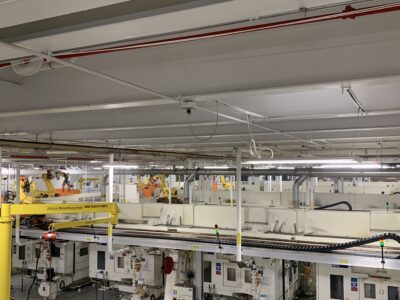
An automated cell including five CNC machines tended by two PLC-controlled robots was operating inefficiently. The CNC machines were experiencing too much idle time while waiting to be loaded by one of the two robots. Although the manufacturer had collected data on some of the suspected contributing variables, the hypothesis on how to improve the cell’s OEE was largely subjective – many people had proposed ideas, but a clear, data-driven solution was required.
When Patti Engineering began working on the project, the team reviewed the program code and captured data. Then, they identified the additional data sets needed to fully describe and characterize the system’s operation including FIS data points and other key features from the machine. The entire data set was extracted to the cloud for further analysis, which confirmed significant disparities in machine servicing patterns and variations in their speeds. The analysis allowed the engineers to identify the problematic portions of the robotic automation that were responsible for the observed loading differences.
Engineers then used Siemens PlantSim, a simulation tool, to both design and verify solutions for improving the cell’s operation. The addition of a nest to the robot fixture was verified to improve the cell’s performance by allowing it to pick up multiple parts at a time. PlantSim was also used to validate a change to the robot’s waiting position, reducing travel time between operations.
While data analytics had revealed the problematic areas of the robot’s processes, PlantSim had allowed engineers to validate solutions that ultimately improved the cell’s OEE.
Closing Thoughts
Just like the Tampa Bay Rays have outmaneuvered their better-funded rivals through data-driven decision-making, manufacturers that embrace AI-based analytics tools will gain their own competitive advantage. These tools address wide-ranging manufacturing challenges, including root cause fault analysis and predictive maintenance approaches that prevent costly downtime. Likewise, AI-based simulation tools provide insights that may otherwise be too difficult to discern, leading to improvements in operational efficiency of complex systems. Finally, vision systems based on machine learning principles increase quality control metrics while continuing to learn and adapt. By utilizing the expertise of system integrators for implementation of foundational data integration strategies, including careful sensor use and other tools that seamlessly interface with legacy systems, manufacturers can mimic the Rays’ winning strategy—consistently outperforming expectations, improving productivity, and thriving amid resource constraints.
Related categories: Blog