
HMI and SCADA Integration: What Manufacturers Need to Know
Most manufacturing plants run both HMI and SCADA systems. Many have integration friction between them: data inconsistencies, communication gaps, alarm systems that don’t agree. Some have systems purchased in different budget cycles that were never properly integrated.
Understanding how these two layers are supposed to work together, and where they commonly fail, is the starting point for diagnosing problems and making informed upgrade decisions.
HMI vs. SCADA: The Distinction That Matters
What an HMI Does
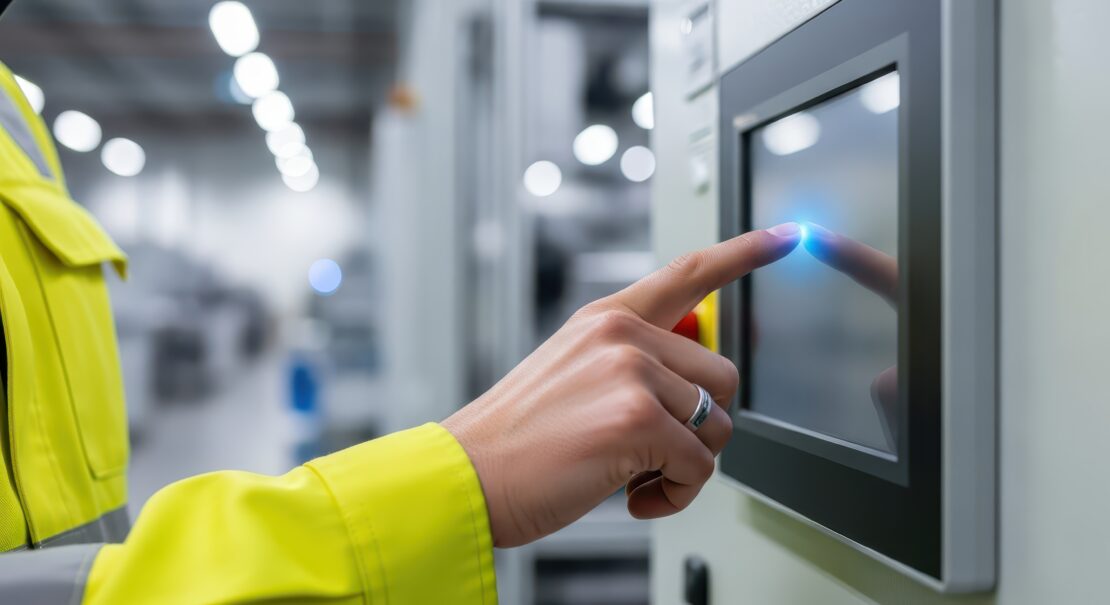
An HMI (Human-Machine Interface) is the local operator interface layer. It gives plant floor operators real-time visibility into machine and process state: temperatures, pressures, speeds, alarm conditions. It allows them to initiate control actions at the machine or line level.
HMIs are machine-specific or line-specific. An operator at an HMI screen is interacting with the equipment directly in front of them.
What SCADA Does
SCADA (Supervisory Control and Data Acquisition) operates at the supervisory layer. It aggregates data from multiple HMIs, PLCs, and field devices across a line, a plant, or multiple sites. It maintains the historian database, runs alarm management and reporting, and gives supervisors and engineers a plant-wide view.
This is where production data becomes useful to manufacturing leadership: OEE calculations, shift reports, batch records, regulatory compliance logging, and the cross-line visibility that drives operational decisions. As manufacturers seek greater visibility and efficiency, investment in these capabilities continues to grow. According to Deloitte, 68% of manufacturers are increasing investments in digital technologies to improve operations and productivity. A plant running production efficiently at the line level but lacking SCADA aggregation is operating blind at the plant level.
Why They’re Often Confused
The distinction has blurred at the product level. Modern SCADA platforms, including Inductive Automation’s Ignition and Siemens WinCC, include HMI functionality. A single deployment can serve both roles. This leads to the terms being used interchangeably even when they describe different functional layers.
The distinction still matters for integration architecture: HMI is local and machine-coupled; SCADA is centralized and aggregating. Leaving the two layers poorly integrated is where most HMI/SCADA problems start.
How HMI and SCADA Work Together in a Manufacturing Plant
The Data Flow
Field devices, including PLCs, drives, sensors, and instruments, communicate process data to the HMI for local operator use and to the SCADA historian for aggregation and storage. In well-integrated systems, this happens reliably, consistently, and in real time. The scale of manufacturing data makes this connectivity increasingly important. Data from the World Economic Forum shows that manufacturers generated approximately 1.9 zettabytes of data in 2024, yet much of it remains underutilized because of disconnected systems.
Alarm conditions detected at the HMI propagate to the SCADA alarm management system. Operator actions at the HMI are logged in the SCADA historian. Supervisors reviewing SCADA dashboards and operators watching HMI screens are looking at the same underlying reality from different vantage points.
What Integration Actually Connects
Effective HMI/SCADA integration connects more than communication paths:
- Tag naming and data models: The same data point needs consistent naming and structure across both layers. Independent configuration produces inconsistencies that corrupt aggregated data.
- Alarm management: HMI-level alarms need to be rationalized against SCADA-level alarms to avoid duplication, missed escalations, and alarm fatigue
- Historian configuration: The SCADA historian captures what the HMI makes available. Logging fidelity depends on how the HMI is configured, not just the historian settings.
- User access and security: Operator access at the HMI needs to be consistent with SCADA-level access controls
Common HMI/SCADA Integration Challenges
Protocol and Communication Mismatches
HMIs and SCADA systems need to share communication protocols or route through a translation layer. OPC-UA has become the preferred standard for modern systems: platform-agnostic, secure, and well-supported. Older HMI installations may use Modbus, proprietary protocols, or legacy OPC-DA. Mismatches between protocol versions and driver configurations create intermittent failures that are difficult to diagnose and easy to misattribute.
Platforms like Ignition carry broad native protocol support, which simplifies integration in mixed-environment deployments where legacy field devices and modern SCADA need to coexist.
Data Consistency Problems
When HMI and SCADA tag databases are configured by different teams at different times, naming conventions and engineering units diverge. If the HMI is reporting temperature in Fahrenheit and the SCADA historian expects Celsius, the data is wrong, and the error may not surface until a quality audit or incident investigation. Consistent tag naming and data model standards across both layers is architectural work, not an afterthought.
Security and Network Architecture
IT/OT convergence that modern SCADA systems enable also introduces security complexity. SCADA systems connecting multiple plant systems to enterprise networks create pathways that need active management. HMI systems originally isolated on the plant floor become attack surfaces once integrated into a broader SCADA architecture.
Network segmentation across the OT zone, DMZ, and IT zone, and maintaining that segmentation as systems expand, is one of the ongoing integration challenges that benefits from an integrator who understands both OT and IT dimensions.
What Good HMI/SCADA Integration Looks Like
Well-integrated HMI and SCADA systems share a consistent data model: the same tag naming conventions, the same engineering units, the same alarm rationalization logic. Communication is reliable and low-latency. The historian captures the right data at the right resolution without gaps or duplicates.
This kind of integration requires defining the data model before building either system, or rebuilding the integration architecture when legacy systems that were never designed to work together need to be brought into alignment. The architecture work is the project; the software configuration is the execution.
When to Bring In a Systems Integrator
A systems integrator is the right resource when:
- You’re deploying new HMI and SCADA systems and want the integration architecture right from the start
- You’re upgrading one layer (new HMI, same SCADA, or vice versa), requiring the integration to be rebuilt for the new configuration
- Your existing systems communicate but produce inconsistent or unreliable data
- You’re adding SCADA visibility to lines that currently only have machine-level HMI
- You’re dealing with persistent integration problems, including intermittent communication failures, alarm inconsistencies, and historian gaps, that internal teams haven’t resolved
The National Association of Manufactures reports that the U.S. manufacturing sector currently employs approximately 12.6 million people across more than 239,000 companies. An integrator with direct experience on your SCADA platform can diagnose problems that generic support channels miss and design solutions that account for your specific legacy constraints. Ignition Gold certification and Siemens partnership are relevant credentials here because they indicate the platform depth required for integration work at this level of complexity.
FAQs
An HMI provides local operator visibility and control at the machine or line level. SCADA aggregates data across multiple machines, lines, or sites, maintaining the historian, managing alarms, and providing plant-wide visibility. Modern platforms like Ignition and Siemens WinCC include both functions in a single deployment, but the functional distinction between local interface and supervisory aggregation still drives integration architecture decisions.
Yes. Standalone HMI systems are common. The HMI provides local visibility and control, which is sufficient for many operational needs. SCADA becomes relevant when supervisory aggregation, historical data, cross-site visibility, or regulatory compliance reporting are required. Adding SCADA capability to lines that currently only have HMI is a common integration project.
OPC-UA is the current standard for modern systems. Older installations may use OPC-DA, Modbus TCP/RTU, or proprietary protocols. Mixed environments often require protocol
translation layers or driver bridges. Ignition’s broad native protocol support is one reason it’s frequently the platform of choice for retrofitting SCADA capability onto mixed-protocol legacy environments.
Tag naming inconsistencies from independent configuration, protocol mismatches or driver version misalignments, network changes that disrupt communication paths, and alarm configuration that diverges across layers over time. In legacy environments these problems accumulate gradually. Each individual change is minor, but the aggregate divergence creates real integration friction.
New integration on a well-defined system with modern platforms: 4–8 weeks for a single line. Complex projects involving multiple lines, legacy equipment, protocol translation, or historian migration typically run 3–6 months. Integrations requiring system rebuilds while production continues add schedule complexity. Timeline estimates are most reliable after an integration assessment that maps the current architecture.
Platform-specific experience on the SCADA and HMI systems you run, familiarity with your type of manufacturing environment, and demonstrated capability on legacy integration work. CSIA certification indicates process discipline and accountability standards. Ignition Gold certification and Siemens partnership indicate the platform depth required for integration work at this level of complexity.
Patti Engineering integrates HMI and SCADA systems across complex manufacturing environments, including legacy retrofits, platform migrations, and new system deployments. Patti is a CSIA-certified integrator, an Inductive Automation Ignition Gold Partner, and a Siemens Solution Partner. To discuss an HMI/SCADA integration project, contact Patti Engineering or learn more about SCADA integration services.
Related categories: Blog Control Systems Integration Industry 4.0 / Digitalization Uncategorized