
FANUC Palletizing Robots: Applications, Capabilities, and Integration Considerations
Palletizing is one of the most natural fits for industrial robotics. The work is physically demanding, highly repetitive, and predictable. A robot handles it faster, more consistently, and without the fatigue, injury risk, or labor retention challenges that come with manual palletizing.
For manufacturers evaluating palletizing automation, FANUC’s palletizing robot lines are among the most widely deployed in the world. Here’s what they do well, how they’re applied across industries, and what integration actually involves, including the considerations that shape the specification before a robot is ever ordered.
Why Manufacturers Automate Palletizing
Palletizing sits at the end of the production line: physically demanding, high-repetition, and often a throughput bottleneck. It’s also a significant source of repetitive strain injuries in manufacturing facilities where it’s done manually.
Robotic palletizers run faster and more consistently than any manual team, don’t fatigue over a shift, and eliminate the injury risk. On high-volume lines, the throughput advantage compounds over the system’s life. On mixed-SKU lines, vision-guided systems handle product variation that would require significant manual labor to manage. According to the National Association of Manufacturers, there were approximately 529,000 manufacturing job openings in the U.S., and the industry is expected to need roughly 3.8 million new workers by 2033. The ROI calculation on palletizing automation is typically among the clearest in the robotics portfolio.
How FANUC Palletizing Robots Work
Robot Models for Palletizing Applications
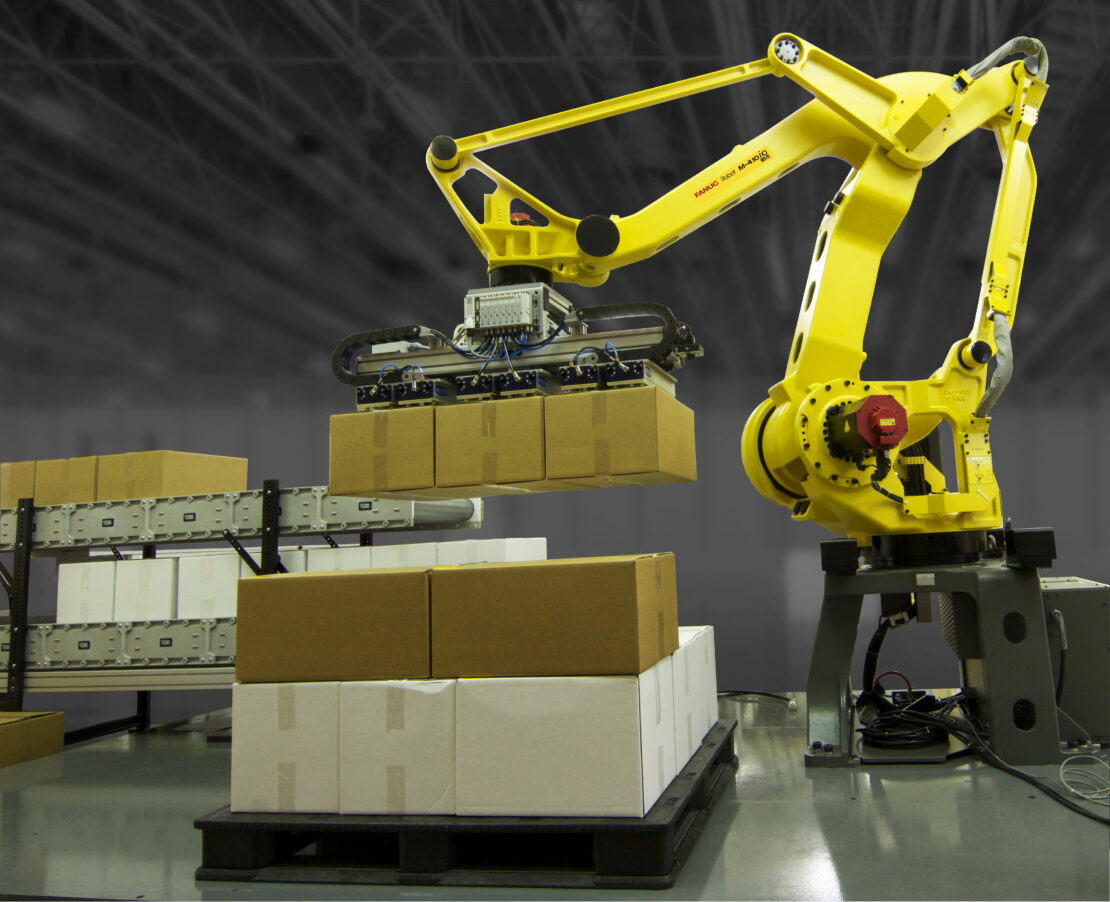
FANUC’s primary palletizing line is the M-410 series, purpose-built for palletizing with the payload range, reach, and wrist configuration optimized for case and bag handling. The M-410iC/185 handles up to 185 kg; the M-410iB/450 handles up to 450 kg for heavy-load applications.
For lighter or mixed applications, the R-2000 series offers more flexibility in a lower-payload range. For very high-payload industrial palletizing, the M-2000 series handles loads up to 2.3 tons.
One specification detail that’s often missed: payload calculations must include the end-of-arm tooling weight in addition to the product being handled. Ceiling height and in-feed conveyor position also affect model selection. The robot’s reach envelope needs to cover the full pallet height and in-feed position without interference. Confirming these dimensions early prevents model selection changes mid-project.
End-of-Arm Tooling: The Interface Between Robot and Product
The end-of-arm tooling (EOAT) is as important as the robot in palletizing applications. The robot provides motion; the tooling is what handles the product.
Common configurations:
- Vacuum cup grippers: Standard for rigid cases, cartons, and bags with a smooth top surface. Fast, reliable, and widely used in food and beverage and CPG.
- Mechanical gripper/clamps: For bags, bundles, or products that don’t hold vacuum
- Layer-palletizing tools: Handles multiple cases simultaneously for high throughput on uniform products
- Hybrid tooling: For facilities with multiple product types requiring different handling approaches
EOAT design and fabrication is handled by the systems integrator, not FANUC. The tooling has to be engineered for the specific product dimensions, weight, and surface characteristics. Off-the-shelf tooling rarely fits without modification, and the tooling design drives a significant portion of the integration project timeline.
Vision Systems and Flexible Palletizing
For applications with variable product orientation or depalletizing requirements, FANUC’s iRVision and 3D area sensors provide flexible pick capability. Vision-guided palletizing is more complex to implement than fixed-pattern applications, but it unlocks applications that aren’t viable with fixed tooling: inbound depalletizing with mixed pallet configurations, flexible case picking for order fulfillment, and bin picking for variable product feeds.
FANUC Palletizing Applications by Industry
Food and Beverage
High throughput, high repetition, and often challenging environments. Palletizing cells in food facilities handle wet or humid conditions, may require washdown-rated designs, and deal with product variability across SKUs. The M-410 series is the dominant choice for case palletizing; throughput rates of 2,000+ cases per hour are achievable on optimized systems.
Consumer Packaged Goods and Distribution
CPG and distribution deal with SKU variety: multiple product types, different case sizes, mixed pallet patterns. Vision systems and flexible tooling allow a single cell to handle product range. Layer palletizing tools increase throughput on uniform products; vision-guided end effectors handle mixed cases.
Automotive and Heavy Manufacturing
Research from the National Association of Manufacturers found that, manufacturing contributes approximately $3 trillion to the U.S. economy, accounting for roughly 9.4% of U.S. GDP. Automotive palletizing often involves heavier payloads, including engine components, stamped parts, and subassemblies, that require the higher-payload end of the FANUC palletizing range. The integration environment tends to be more complex, with tighter coordination requirements between the palletizer and upstream manufacturing lines.
Pharmaceutical and Regulated Environments
Pharmaceutical palletizing adds requirements beyond standard industrial applications: cleanroom compatibility in some deployments, regulatory documentation requirements, and validation processes (IQ, OQ, PQ) that govern installation, testing, and modification. Integrators working in pharmaceutical environments need familiarity with validation protocols and the documentation standards those processes require. This is where integration experience in regulated industries is a real differentiator.
Palletizing Robot vs. Collaborative Robot: Which Application Is Which
Many palletizing applications don’t require a full industrial palletizer. Collaborative robots (cobots) with palletizing configurations are a viable option for lower-throughput applications, lighter payloads (typically under 25 kg), and facilities where frequent layout changes or close human-robot proximity are design requirements.
Industrial palletizers like the FANUC M-410 series are the right choice when throughput requirements exceed what cobot cycle times support, when payloads are above the cobot range, or when the application runs a defined, high-volume production pattern that doesn’t require frequent reconfiguration. The specification decision between industrial and collaborative palletizing depends on throughput, payload, and operating environment, rather than a default assumption about which system type is superior.
What Integration Involves
Line Integration and Conveyor Coordination
A palletizing robot sits at the end of a production line and coordinates with in-feed conveyors, accumulation systems, pallet dispensers, stretch wrappers, and outbound interfaces. Getting the in-feed timing and accumulation logic right is often where integration projects spend the most time. The robot is the straightforward part; the surrounding line coordination is where complexity concentrates.
The control system integration, typically a PLC coordinating robot, conveyor, and cell peripherals, requires the integrator to handle both the robot layer and the broader line controls work.
Programming and Pattern Configuration
FANUC palletizing robots use FANUC’s KAREL and TP programming environments, with palletizing-specific software tools for pattern configuration. Pattern changes, including new products and new pallet configurations, are routine in production environments. Designing the system so that pattern changes are accessible to plant staff without requiring integrator involvement for every change is part of good cell design.
Safety Systems and Cell Design
Palletizing cells operate in or near areas with forklift and manual traffic. Safety cell design, including fencing, light curtains, area scanners, and safety-rated robot motion, must account for the actual traffic patterns at the specific installation.
Safety system design is governed by ANSI/RIA R15.06 and ISO 10218. Integrators should demonstrate risk assessment documentation and safety validation work as part of project deliverables. CSIA certification is a relevant credential here: it indicates the integrator applies systematic project management and documentation practices, including the safety and validation documentation that palletizing installations require.
What to Evaluate Before Specifying a FANUC Palletizing System
These inputs drive the specification:
- Payload and reach: Current product weight plus EOAT weight, pallet height, in-feed position, and ceiling height. Together these determine the robot model.
- Throughput requirements: Cases or units per hour at peak production rate
- Product variability: Number of SKUs, case size range, surface characteristics. This determines tooling configuration and whether vision systems are needed.
- Facility layout: In-feed height and position, pallet staging area, ceiling height, upstream and downstream system interfaces
- Future production changes: Products you expect to add or change. Designing only for today’s SKUs creates limitations when the line expands.
Defining these before engaging an integrator produces more accurate proposals and prevents specification changes mid-project.
FAQs
The M-410 series is FANUC’s purpose-built palletizing line, covering payloads from 140 to 450 kg and optimized for palletizing reach and wrist configuration. The M-2000 series handles very high-payload applications up to 2.3 tons. The R-2000 series covers lighter applications and offers more flexibility for mixed use. Model selection depends on payload range (including EOAT weight), reach requirements, and throughput targets, and should be confirmed with a layout drawing before committing.
Cycle times depend on product type, EOAT configuration, pallet pattern, and in-feed accumulation design. Optimized FANUC M-410 systems can reach 2,000+ cases per hour on uniform products. Mixed-SKU applications or complex pallet patterns run slower. An integrator should provide cycle time analysis based on your specific application before finalizing the specification.
Yes, with appropriate vision system and tooling configuration. FANUC iRVision and 3D area sensors enable flexible pick from mixed or variable product feeds. Hybrid tooling handles multiple product types in a single cell. The complexity and cost of the system scales with the degree of product variability. Uniform, predictable products are simpler and less expensive to automate than highly variable ones.
Footprint varies based on robot model, pallet dimensions, in-feed conveyor configuration, and safety fencing layout. A compact single-robot cell with standard safety fencing typically requires 150–300 square feet for the robot and pallet staging area, plus in-feed conveyor and buffer. Layout planning is part of the integration design. The integrator provides a layout drawing before the project is committed.
From kick-off to production start-up: 4–6 months for a standard single-robot cell on a defined application. More complex projects involving multiple robots, high product variability, or significant line integration typically run 6–9 months. Timeline is driven as much by EOAT fabrication and testing, controls integration, and safety validation as by robot installation. Pharmaceutical applications add validation documentation time.
Working with a FANUC authorized integrator provides direct access to FANUC’s technical support channel, warranty alignment, and the accountability that comes with the authorized partner relationship. For complex palletizing cells involving multiple robots, vision guidance, pharmaceutical validation, or production-critical timelines, that direct FANUC support access is a practical advantage, not just a credential.
Patti Engineering is a FANUC Authorized System Integrator with experience on palletizing applications across food and beverage, pharmaceutical, automotive, and distribution manufacturing. If you’re evaluating palletizing automation or specifying a FANUC palletizing system, contact Patti Engineering to discuss your application or learn more about Patti’s FANUC integration capabilities.
Related categories: Blog FANUC